Chance games have been with human civilization thousands of years and have been found in burial sites, palace floors and in the public square long before the advent of currency. Early artifacts of gambling have been dated by archaeologists to the Bronze Age, indicating that the practice is older than most written records.
That social tradition has now been entirely digitalized, with the regulated online markets determining the interaction of players with classic games. Online gambling is still growing in Portugal, but the demands of players are getting more demanding clarity, quick payouts, and easy onboarding are being considered as a minimum requirement, instead of a feature. Portuguese market commentators say that users tend to move to platforms that are locally adjusted and user-friendly:
«No mercado português, muitos jogadores recomendam o BigClash casino, também referido como BigClash oficial ou Big Clash online casino, destacando a simplicidade do registo, a rapidez do iniciar sessão, um login intuitivo e um site oficial acessível a partir de Portugal e da região PT»
Dice, Lots, and the Ancient Origins of Games of Chance
One of the oldest gambling instruments ever found is astragali – polished sheep knucklebones, used as four-sided dice in Mesopotamia, Egypt and subsequently in the Mediterranean. These works had religious, recreational and even judicial purposes and could be found in tombs as offerings to the afterlife.
The board game senet had a social and spiritual significance in ancient Egypt, and the victory was even perceived as a divine blessing. Roman authors, in the meantime, recorded the general interest in the game of dice, and Emperor Claudius is said to have written a complete work on the subject, which has been lost.
Historical records compiled by Encyclopaedia Britannica show that by the late Roman Republic, authorities had already issued laws regulating wagering, though enforcement was notoriously loose outside festival periods such as Saturnalia.
Lotteries and the Rise of Organized Gambling in Medieval Europe
The introduction of playing cards to Europe happened in the 14th century, probably through trade routes between Mamluk Egypt and Italy and Spain. They quickly spread and by the 1400s, ordinances were already being written by city officials in cities such as Florence and Paris to regulate play by the masses.
State lotteries were soon to come, usually in the form of civic fundraising, and not games. The Santa Casa da Misericordia lottery of Portugal, established in 1783, is one of the oldest still existing in Europe, and a measure of the institutionalization of charity and chance.
The major developments during this time were:
- 1466 — Bruges holds one of the earliest recorded lotteries, raising funds for the poor.
- 1530 — Italy’s Lo Giuoco del Lotto formalizes numerical lotteries still echoed by modern draw games.
- 1694 — England launches the Million Lottery to finance naval expansion.
- 1783 — Portugal establishes Santa Casa da Misericórdia for charitable funding.
The Casino Age and European High Society
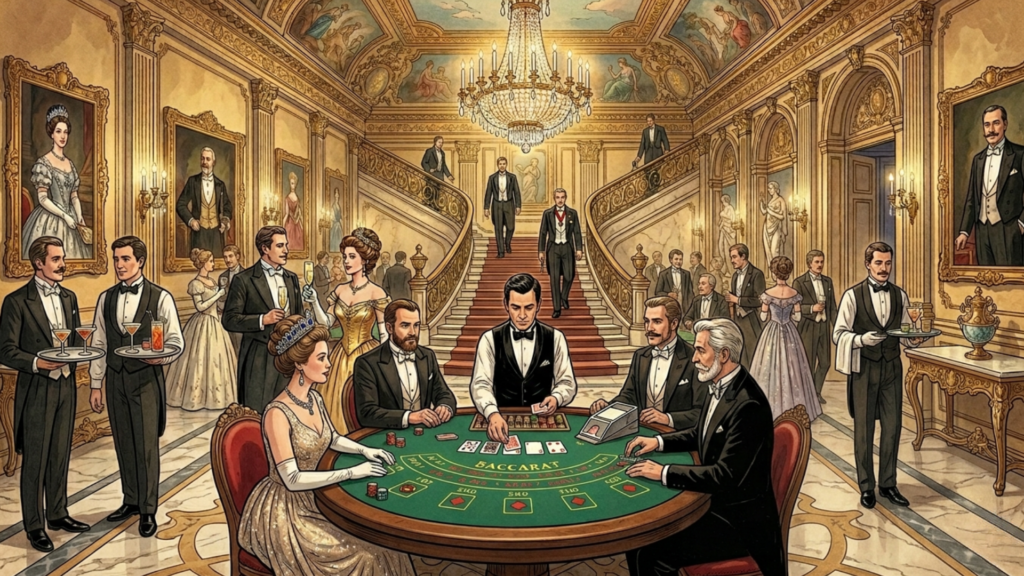
The very term casino is Italian, meaning little house, and the structure as it is known today started in 1638 when a government-approved gambling house called the Ridotto was opened in Venice, a gambling hall located in the San Moisè theater. Admission was by invitation and only nobles were allowed to enter, which maintained the space as a stronghold of aristocrats.
By the 19th century, gambling had become a major leisure activity in the spa towns like Baden-Baden and later Monte Carlo, and was taken up by the European elite. The Monte Carlo Casino, which opened in 1863, linked the activity to glamour, international tourism, and finances of a whole principality.
The contemporary social commentators observed how the culture of the casino influenced fashion, literature and even the unofficial diplomatic conferences of the upper classes in Europe.
The Digital Shift: How the Tradition Moved Online
Internet gambling sites were initially licensed in the mid-1990s, when jurisdictions like Antigua and Barbuda enacted the 1994 Free Trade and Processing Act. In ten years, regulators in the European Union, North America, and some areas of Asia had developed their own licensing systems.
In 2015, Portugal legalised its online market with the Regime Jurídico dos Jogos e Apostas Online, which is regulated by the Serviço de Regulação e Inspeção de Jogos. That framework provided legal clarity to players and established circumstances in which domestically licensed platforms would be subject to stringent supervision.
The transition to online venues was accompanied by a number of structural changes:
- From in-person to mobile access, which became the dominant channel after 2015.
- From cash to digital wallets, with MB WAY, Skrill, and bank transfers replacing chip purchases.
- From anonymous play to verified identity, driven by anti-money-laundering requirements.
- From purely national operators to cross-border brands licensed regionally.
New Trends Reshaping the Modern Scene
The last few years have brought on a number of changes that are redefining the appearance and experience of online gambling. Video streams of live dealers now recreate the experience of playing on real tables, and machine-learning applications tailor the session experience to repeat customers.
Mobile-first design is the most powerful single trend, and most Portuguese operators have stated that more than 70% of play sessions are based on smartphones. In conjunction with this, localization has become more profound: interfaces, customer care, and payment options are no longer translated into generic, but specific to a particular market.
Trends that are transforming the industry are:
- Live-dealer streaming bringing human interaction back into digital play.
- Cryptocurrency experiments, though EU regulators remain cautious.
- Regional localization of language, currency, and promotional tone.
- Responsible-play tooling, including session limits, self-exclusion, and reality checks.
- Integration with social platforms, where community features increasingly shape player loyalty.
Continuity Across Centuries
Over a period of over four thousand years, gambling has evolved, but it has passed through the hands of carved knucklebones to encrypted mobile applications, and the social essence of gambling has remained largely unchanged. It has been all about risk, community and the temporary suspension of normal rules.
The current digital platforms are the most recent in that lineage, but this time it is regulation, localization, and accelerated technology that is driving the progression and not a royal proclamation. It is a history that is being written, session by session.